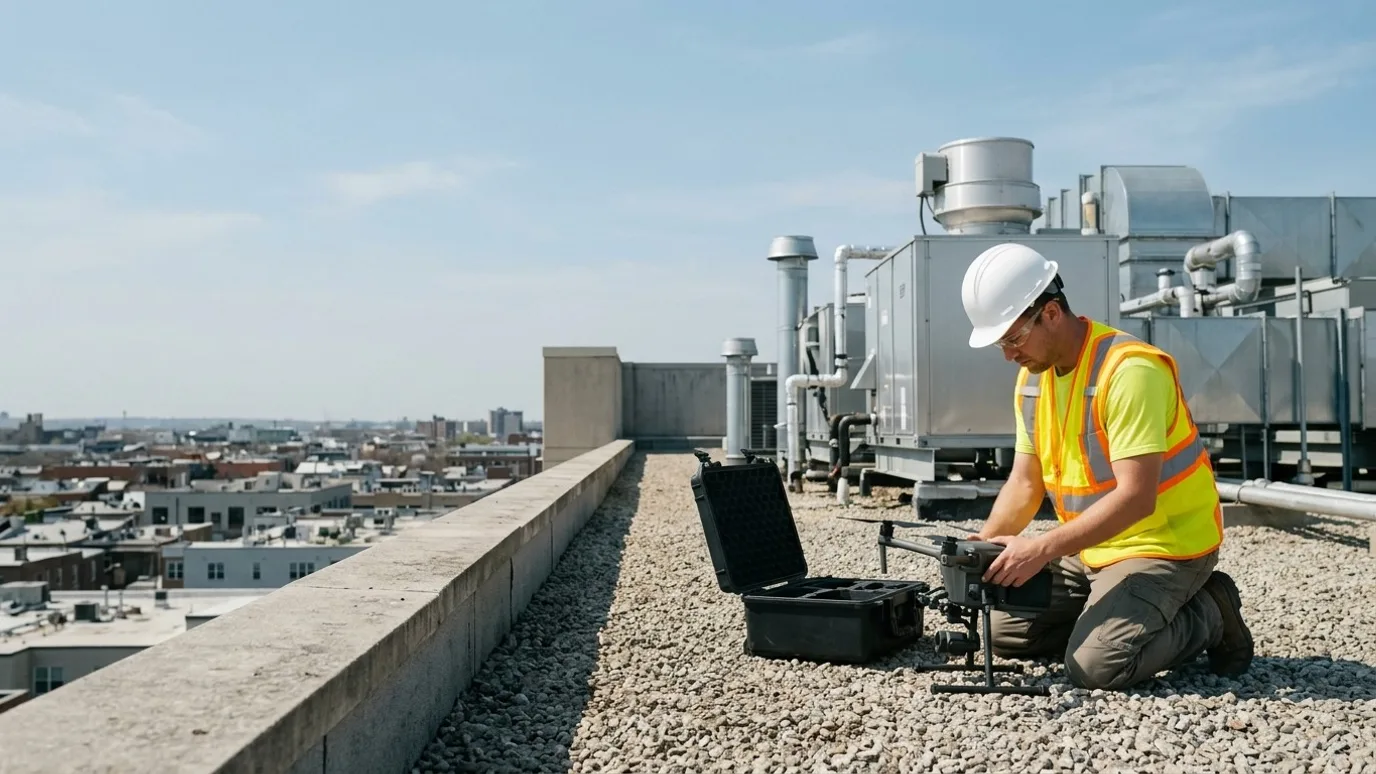
Property management
Every roof in the portfolio, on record, before the capital plan is written.
Condition surveys, thermal moisture scans, dated baselines and storm response for property managers and the owners and boards they report to.
Canada-wide · Transport Canada Advanced RPAS · Commercially insured
Know the condition of what you manage without sending anyone up.
This is for commercial and residential property managers, strata and condo managers, and the owners, boards and councils they report to.
Roofs and envelopes fail quietly until they do not. The usual signal is a tenant complaint, and by then the repair is bigger than it needed to be. Getting ahead of it means someone on the roof, which costs money and does its own damage.
A drone survey covers every roof and facade in the portfolio the same way, finds moisture with thermal, and gives you a dated record the contractor quotes from and the board can look at. No one goes up until the work starts.
Progress
Capital projects and portfolios, tracked the same way
Re-roofs, envelope repairs and site works captured from the same positions, across every building you manage.
Portfolio baseline
Every roof and facade surveyed the same way on a schedule, so the capital plan starts from a record rather than a complaint.
Project progress for the board
A re-roof or recladding captured at each stage for the owner or the strata council, in a link.
Tenant and site records
Parking, landscaping, loading and site condition documented for lease disputes and maintenance planning.
Where the saving is
A board that can see the roof does not need the site visit or the second opinion. The saving is time in the meeting and a capital plan with fewer surprises.
Quality
Find the leak before the tenant does
Thermal and visual surveys that locate moisture, failed seams and ponding, on the plan, with imagery your contractor quotes from.
Thermal moisture survey
Wet insulation located after sunset, paired with the visual, on the roof plan. Core where it says, not where you guess.
Contractor-ready findings
Numbered observations a roofer or envelope consultant can quote from without their own site visit.
Warranty and claim records
Dated baselines and post-event captures, from the same positions, for the insurer and the manufacturer.
Where the saving is
A targeted repair instead of a full replacement, or a replacement done before the interior damage, is the saving. The survey is a fraction of either.
Safety
Nobody on the roof to have a look
Inspection done from the air, so the membrane is not walked and no one is at height for a survey.
No ladder, no lift, no anchors
The survey needs none of them and does not damage the roof.
High and awkward buildings
Upper facades, steep roofs, mechanical penthouses and skylights inspected at the same resolution as everything else.
Storm response
Post-event capture of every roof in the portfolio, compared to baseline, before anyone is sent up.
Where the saving is
Contractors and staff not working at height for a look is the saving, along with the roof that was not damaged by the inspection.
Services for property management
What we do on these sites
- Roof and building inspectionThe core service: visual and thermal survey with an annotated report on the roof plan.Read more
- Construction progress monitoringStage captures on re-roofing, recladding and site projects for the board.Read more
- 360 aerial panoramasOne link that shows an owner or a prospective tenant the property from above.Read more
- Interior 360 site walksTenant improvement and vacant space records, walked and pinned to the plan.Read more
FAQ
Questions property management teams ask
How often should a portfolio be surveyed?
Annually for the visual baseline, with thermal every two or three years or when a leak is suspected. Plus after any significant storm. The first survey is the baseline; every one after it is a comparison.
Can you do several buildings in one visit?
Yes. Buildings on one site or in one area are surveyed the same day, the same way, and reported per building. Portfolio pricing reflects that.
Is this only for large, multi-year projects?
No. The smallest programmes we run are a few visits over a single phase, or a single inspection of one building. What matters is whether someone needs to see or measure something they cannot easily get to. Project size is not the deciding factor.
What if our site is in controlled airspace?
Most urban sites are. Every operator we dispatch holds the Advanced RPAS certificate, which is the one that permits controlled airspace flight, and we request NAV CANADA authorisation before each visit. It adds lead time to the first capture, rarely to the cost.
Who owns the data?
You do. Every photo, video, map and model is yours to use however you want, with no licensing fee and no expiry. We keep a copy for the duration of the project in case a file goes missing on your side, then delete it unless you ask us to keep it.
Can you provide a certificate of insurance naming our company?
Yes. Commercial liability insurance for RPAS operations, with a certificate naming your company or the owner as required by your contract. Ask for it at scoping and it arrives with the quote.
How fast can you be on site?
It depends on where the site is and whether airspace authorisation is needed. Tell us the location and we will give you a date. Ben flies personally where he can and dispatches a vetted, licensed, insured operator elsewhere in Canada. Either way, Lensdrone is the one accountable operator of record.
Next step
Tell us about the site.
Anywhere in Canada. Send the basics and Ben will come back as soon as he can with a scope and a price. If you would rather talk, call.
- Call Ben
- +1 778 889 9306
- [email protected]
- Ballpark in 60 seconds
- Instant estimate